The pages within this guide.
Static Mixing Guide
In this static mixing guide, we will discuss the process and how we go about selecting the correct static mixer for your application.
"Do you need an agitated tank or could you use an inline pipe static mixer?"
Fluid mechanics such as plug flow, Reynolds number, and pressure drop play a key role.
The mixer length and the number of mixing elements based on the mixing device are based on experience and laboratory studies. We will shed some light here as well.
The most common applications are blending of chemicals.
Dispersions, whether gas-liquid or liquid-liquid, are critical in some processes.

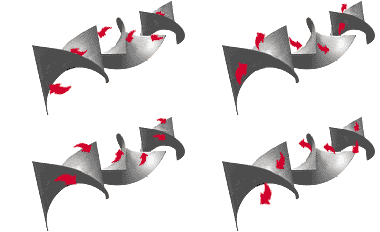
Characteristics of a Static Mixer
Simple Construction
- Consistent Cross-Sections
- No Space for Fluid Buildup.
Metrics:
- No Pressure Loss
- Easy to Upgrade
- Easy to Clean
Inline Construction
- Shut Out From Outside Air
Metrics:
- Safe Working Environment
- Clean Operation
- Space Saving
Radial Mixing
- Nearly Ideal Piston Flow
Metrics:
- Safer Control Systems
- Continuous & Uniformed Operation
- Easy Expansion
No Actuator
- Maintenance Free
Metrics:
- Nearly No Wearing Parts
- Simple Installation
- No Power Supply Necessary
Metrics:
- Energy Efficient
- Explosion Safe Area Installation Possible
| Mixing of Liquid-Liquid | Mixing of Liquid-Gas | Mixing of Gas-Gas | For Testing |
|---|---|---|---|
| Mutual Solubility of Two Liquids (Good) | Drainage pH Adjustment | Adjusting of Atmosphere Gas | Visual Observation of the Fluid Mixture |
| Mutual Solubility of Two Liquids (Bad) | Aeration | Gaseous Fuel Adjusting | Test by the Small Lots |
| Dilution, Neutralization, Compounding | Carbonation | By-product Gas Recycling | |
| Dispersion, Extraction, Emulsification | Deoxidation of Organic Liquid | Denitrification of Flue Gas | |
| Addition/pH Adjustment | Temperature Homogenization of High Temperature Gas | ||
| Alkali Cleaning | |||
| Super Critical Liquid Extraction |
| Chemical Fiber Spinning Process Use | Extruder Use | Injection Molder Use |
|---|---|---|
| Improvement of the viscosity and the temperature irregularity in the distribution tube. | Improvement of the viscosity and the temperature irregularity occurring in the extruder. | Improvement of the viscosity and the temperature irregularity occurring in the injection molder. |
| Dissimilar Polymer Blend | ||
| Improvement of the viscosity and the temperature irregularity in the spinning nozzle. | ||
| Mixing of Additive |
| Direct Heating (Injecting steam directly into liquid to condensate) | Direct Cooling (Injecting cold water directly in steam to vaporize) | Indirect Heating (Heating of heat transfer liquid) | Indirect Cooling (Cooling of refrigerant liquid) |
|---|---|---|---|
| Warm Water Production | Temperature decrease and low pressure steam production | Heating of the process liquid | Cooling of the process liquid |
| Heating of Chemicals | Heating of the chemical raw materials (polymer) | Cooling of the raw chemical materials (polymer) | |
| Heating of Slurry | Viscosity adjustment by flash heating the coating liquid of de-monomers | Cooling of raw food materials | |
| Heating/Sterilization of highly viscous liquid. | Viscosity adjustment of coating liquids |
| Chlorination reaction | Absorption of low pressure liquid |
| Production of Ammonia Water | Absorption collection of reaction gas |
| Production of Liquid Bleach of Pulp | Production of Ozone Water |
Frequently Asked Questions
Discover everything you need to know about ZAIN Industrial—from our high-performance stirred tanks, reactors, ceramic filters, and static mixing guides to expert support that helps you optimize processes and achieve long-term efficiency.
Who is ZAIN Industrial?
ZAIN Industrial is a leading expert in industrial mixing solutions. We specialize in providing consulting services, Mixing tanks and reactors as well as Field Services.
What does glass lining inspection involve?
We perform visual inspections to identify cracks or chips, spark (holiday) testing to detect micro-defects, and thickness measurements to check for wear or erosion. We compile all results in a maintenance log for long-term tracking and compliance.
How often should inspections be conducted?
We recommend annual inspections as part of your preventive maintenance program. Some high-use or corrosive-process systems may require check-ins every 6 months to avoid unexpected failures.
What repair methods do you offer?
Minor defects can often be fixed with on-site patch plugs, sleeves, or PTFE repairs. For severe wear or damage, we offer full reglassing services that restore vessels to like-new quality while often reducing cost compared to full replacement.
Can seals and agitator components be checked during inspection?
Yes. Our inspections cover agitator shafts, drive seals, baffles, nozzle connections, and gaskets. We'll identify worn or corroded elements and recommend replacements or adjustments to avoid further liner damage .
Is your inspection service compliant with safety regulations?
All services comply with OSHA confined-space entry, lockout/tagout, and process safety protocols. We document every step to support regulatory requirements such as FDA or cGMP audits.
What is the timeline for inspection and repair?
Standard on-site inspections with minor on-site repairs can be completed within a day or two. If reglassing is needed, total turnaround is typically several weeks, significantly faster than sourcing new equipment .
Can a vessel be refurbished rather than replaced?
Yes—if the steel substrate is in sound condition, reglassing is often the most cost-effective solution. It restores full functionality at around 60‑70% of the cost of new equipment and preserves existing infrastructure .
When is a reactor not a candidate for repair?
If the steel shell has advanced corrosion, structural damage, or if capacity needs changes, replacement may be preferable. Our inspection report includes a technical recommendation to guide decision-making.
Reach Out or Visit Us Now!